 Contemporary American Short Stories, edited by Hans-Heinrich Rudnick (Reclam Publishers, Germany).
Table of Contents:
K. Vonnegut: The Mannes Missiles – W. S. Merwin: Vanity – J. Barth: Autobiography; A Self-Recorded Fiction – D. Barthelme: The Glass Mountain – J. Updike: A & P – G. Godwin: His House – T. Pynchon: Entropy – J. C. Oates: How I Contemplated the World from the Detroit House of Correction and Began My Life Over Again – P. Graham: Light Bulbs
Excerpt from “Light Bulbs”—originally published in The New Yorker:
Mother and Father seldom hear from the children. Their daughter, living alone in Asia, writes letters in a calligraphy so beautiful that they have stopped having them translated. Instead, Mother laminates them for use as placemats. The graceful characters enhance the irregular swirls of spilled gravy, the random drips of coffee. And the twins, who recently swapped spouses and are fighting over custody of their children, rarely call.
Home remains quiet. Mother and Father never were great talkers, and they still aren’t; they keep busy in other ways.
Lately, the light bulbs have begun to go out in an unpredictable and alarming way.
*
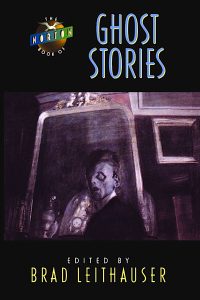
The Norton Book of Ghost Stories, edited by Brad Leithauser (W. W. Norton).
“Included are the most intriguing works by the writers who have defined the genre over the years—Henry James, Oliver Onions, and M. R. James—as well as stories by other authors whose forays into the supernatural are less well known: V. S. Pritchett, Muriel Spark, John Cheever, A. S. Byatt, Elizabeth Taylor, and Philip Graham among others.” —from the book jacket description of The Norton Book of Ghost Stories.
“Philip Graham’s beautiful and moving story ‘Ancient Music’ . . . about love and loss in old age, is a gentle valedictory embrace between the elderly Mr. and Mrs. Michaels on the eve of Mr. Michaels’s death.”
—John Banville, The New York Review of Books
Excerpt from “Ancient Music”:
When Mr. Michaels died in the early morning, he floated up through the bedsheets to the ceiling, then slowly into the attic, the old suitcases and rolled-up rugs barely visible in the dark. Finally, his eyes breached the roof and the shingles receded as he quickly drifted up into the air. But the long view of the surrounding town and the distant horizon, the sun still hidden, made him dizzy. There wasn’t any place he wanted to be but home, so he imagined his feet were weighted, each toe fat, each foot heavy.
He slowly fell and thought of where he wanted his feet to take him: to the kitchen for the breakfast smell of butter melting into toast, then to the living room to feel the serrated edges of the rare domestic issues of his stamp collection. As he thought of the thick lenses of his glasses on the night table, his feet slipped through the bedroom ceiling, his entire form descending in the air to the carpeted floor. There he stared at his still body and waited for his wife to wake up. It wasn’t until she opened her eyes that he realized what she saw–his quiet figure, its absence of breath easily discovered as she placed her palm against his nostrils. Then she slowly moved her hand down to his chest and held it there for a very long time, her face pressed against his shoulders.
*
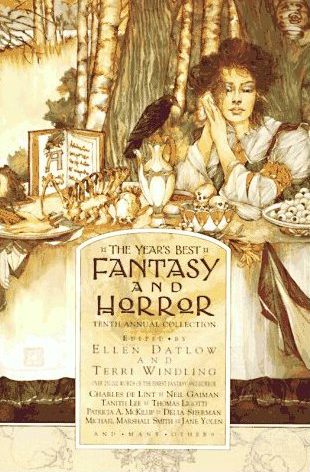
The Year’s Best Fantasy and Horror (Tenth Annual Collection), edited by Ellen Datlow and Terri Windling (St. Martin’s Griffin).
Included in the anthology is work by Robert Olen Butler, Angela Carter, Neil Gaiman, Ron Hansen, Gabriel García Marquez, Robert Silverberg, and Gerald Vizenor.
“The following beautifully written story, ‘Angel,’ comes from Graham’s most recent collection, Interior Design . . . This mainstream collection contains a number of stories that cross the line into contemporary fantasy. This is a beautifully textured book, and well worth seeking out for both its realist and fantasy tales.”
—Ellen Datlow and Terri Windling (from the anthology’s introduction)
Excerpt from “Angel”:
In the den, Bradley settled himself into a chair. The television was already on and waiting for him, busy with laughter and applause. Even with his eyes closed he could barely make out the indistinct murmur of his parents’ voices. He wondered if their angels spoke to each other, revealing secrets about his parents that he would never know. Then he felt a salty twinge, and he concentrated on the potato chip dissolving on his tongue. Angels don’t like to eat, he remembered Father Gregory once saying, because the thought of mixing food with their angelic form upsets them. But they like for us to eat, and they try to imagine taste, try not to think of digestion. In an effort to endear himself, Bradley decided to describe his experience for his angel. First, it’s very salty, he thought, your tongue wants to curl up, and it’s hard not to chew. When the chip starts to go mushy, you can press it–very softly–against the roof of your mouth with your tongue, and then little pieces break away. They melt very, very slowly.
*
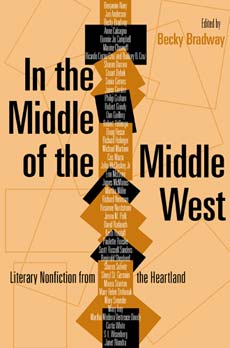
In the Middle of the Middle West: Literary Nonfiction from the Heartland, edited by Becky Bradway (Indiana University Press).
Writers featured in the anthology include Stuart Dybek, Bonnie Jo Campbell, Robert Hellenga, Michael Martone, Cris Mazza, Scott Russell Sanders, Sharon Solwitz, Maura Stanton and Curtis White.
Excerpt from “The Baby Shower”:
We were among the last to arrive, and so most of the guests sitting on the floor in the living room, circling the pile of presents, had clearly already accustomed themselves to their surroundings. But Alma and I couldn’t help gaping at the fake palm tree in one corner of the room, the fake thatch eaves lining the top of each doorway. And then there was the meticulously detailed mural of a Polynesian beach filling the full stretch of one wall: a painted stand of palm trees swaying above an inviting curve of white sand flecked with seashells, and a serene blue water’s reflection of stars in an evening sky.
The other walls, however, were inexplicably lined with carpet patches.
*
Turning Life into Fiction, edited by Robin Hemley (Graywolf Press).
“The writer Philip Graham was born in Brooklyn, and yet the places that have exerted the strongest influence on his imaginative life, and hence his fiction, are West Africa and the Midwestern United States. Graham has lived in Champaign-Urbana, Illinois, for the past two decades, but he’s also spent quite a lot of time in the Ivory Coast, supporting the research of his wife, anthropologist Alma Gottlieb. Africa informs every story he writes, Graham says, though virtually all his stories are set elsewhere. One normally wouldn’t pair the Midwest and Africa, but that’s why Graham sounds unlike any other writer you’ll encounter, why his stories are familiar and simultaneously extraordinary.”—Robin Hemley
Excerpt from the short story, “Interior Design”:
These days I just won’t get out of bed, so I lie here, idly kicking the sheets into strange patterns—a ripple of dunes, a mountain range—and I imagine I’m a peasant woman in Turkey, working alongside her husband, carving out a home from one of those cliffs of soft volcanic rock. I can see our faces and hands dusty and smeared with stone shavings and sweat, two strange creatures chipping away new rooms as we need them, and I wonder if we’ll agree on every odd turning we take in the rock, every little nook or window we each wish.
So as an interior designer, I always saw myself as a medium, helping my clients discover the house they wanted to have in the house where they already lived.
I asked, “Where would you really like to live?” and I listened to their idiosyncratic, secret dreams of home.
*
Words Overflown by Stars: Creative Writing Instruction and Insight from the Vermont College MFA Program, edited by David Jauss (Story Press).
Excerpt from “Wake Up and Go to Sleep: Dreams and Writing Fiction”:
Writing about dreams will always be fraught with false paths and unforeseen traps. But why would any writer wish to avoid taking on what is difficult, especially when embracing that difficulty could lead to more compelling characterization and a richer fictional world?
While dreams may be terrain that could challenge even the fittest writer, their place in our experience is also so common that they can be shockingly easy to overlook. And yet so bracingly welcome when revealed. Andrew Allegretti certainly provides a moment of recognition when he begins his short novel, A Fool’s Game, with the sentence, “The doctor and the doctor’s wife lay close in their close bed, their bodies stirring with restless dreams.”
These dreams resolve nothing in their relationship; upon waking the couple soon go about their morning rituals, the truths of their separate dreams left behind. Though one almost never reads of parallel dreamscapes such as these, these twinned interior states play themselves out within couples who lay beside each other in bed millions, billions of times around the world every night. It’s one of the most common features of human existence, far more common than those same couples having sex that night, or having breakfast together the next morning.
*
Now Write! Nonfiction: Memoir, Journalism, and Creative Nonfiction Exercises
from Today’s Best Writers and Teachers, edited by Sherry Ellis (Tarcher/Penguin).
Excerpt from “Can You Hear Me Now?”:
Our relationship with the vocal tones of those with whom we are emotionally entangled is indeed complex. People say the opposite of what they mean, or their words contain multiple shades of meaning. How do we separate what we hear from what we wish to hear or what we’re told we should be hearing?
Sound reluctantly reveals its mysteries—not only speech, but whatever sets off vibrations in the air. No telephone merely rings. We co-create the sound that calls to us. Anticipating his lover, a man will approach the ringing phone with pleasure; the ringing during dinner—perhaps a telemarketer’s call—sounds abrasive, ugly; and the ringing that wakes us in the night is tinged with our confusion and dread. Each ring sounds different—we provide the emotional notes that create different harmonics.
*

Being There: Learning to Live Cross-Culturally, edited by Sarah H. Davis and Melvin Konner (Harvard University Press).
Excerpt from “Mad to Be Modern”:
I looked up from the table, and there was that fellow we’d met at the soccer game, the odd one. He stood too close to me, smiling, but I’d grown used to my sense of personal space being violated—the Beng standard of curiosity demanded close quarters.
I went through the usual exchange of morning greetings and prepared to return to my typewriter when he backed away a few steps and brought something he held in his hand up to his face, positioning it. It looked like one of those Marlboro cigarette hard packs. Avoiding Beng once again, he said, “Bonjour,” made a clicking voice, moved a foot to his left, and clicked his tongue again.
The cigarette pack, I guessed, was his idea of a camera, and when he clicked again I decided to go along with the joke. I sat up straight and drained my face of all humor or expression—the typical stiff expression of a Beng person posing in front of a camera. Two could play at this game of cultural reversal.
Soon enough, he held out his cigarette pack for me to admire. He’d cut out a circular hole near the top of both sides and used the excised cardboard to fashion the raised rim of a lens. He’d even rigged up a little square in one corner as a viewfinder. Clearly, his little joke was more premeditated than I’d imagined.
“It’s my camera,” he said in French, “and me, I’m the Prime Minster.”
*
The Rose Metal Press Field Guide to Writing Flash Nonfiction,
edited by Dinty W. Moore (Rose Metal Press).
Contributors include Jenny Boully, Rigoberto Gonzalez,
Robin Hemley, Patrick Madden, Brenda Miller, Kyle Minor,
Lia Purpura, Sue William Silverman.
Excerpt from “The Ant in the Water Droplet”:
The memories we have of our lives are not a continuous narrative. Instead, they are more akin to the several arcs of a skipping stone—three, four, five, six splashes and onward. Flash nonfiction is in many ways an ideal form to capture the world of those splashes of memory, fueled by the energy of the previous arc’s path descending into the water, as well as, at the end of the brief essay, the energy urging up to the curve of another arc. In this way of thinking, a flash nonfiction piece doesn’t have a beginning so much as a point of entry, and a point of departure rather than an ending. In much the same way poetry employs negative space, a flash nonfiction piece can imply and silently give shape to its before and after.